Amazon's Massive Delivery Forecast, Extended Peak Season & The End of Easy Returns: The Latest Logistics News
Amazon Forecasts Record U.S. Delivery Volume for 2026
The Amazon logistics machine is not slowing down. A new report indicates that Amazon is forecasting a staggering increase in the number of packages its delivery network will handle in the U.S. this year.
Amazon's latest preliminary forecast puts its own delivery network at 86.3% of its US packages in 2027, 87.4% in 2028, and 88.7% in 2029, according to an internal planning document from late July. The shift is happening faster than Amazon previously projected. Its prior estimates put first-party delivery at 83.8% of US packages in 2027 and 85% in 2028, according to the document.
In 2023, the company said it delivered over two-thirds of its own packages in the US, the last time it publicly disclosed that figure. Amazon's latest plan projects that its own delivery network would handle roughly 12.2 billion US packages in 2027, growing to 15.8 billion in 2029.
By internalizing more volume, leaning heavily into its regionalized fulfillment nodes, and scaling its Delivery Service Partner (DSP) program, Amazon continues to aggressively widen the gap between itself and legacy carriers like UPS and FedEx in total domestic parcel volume.
Source: Business Insider
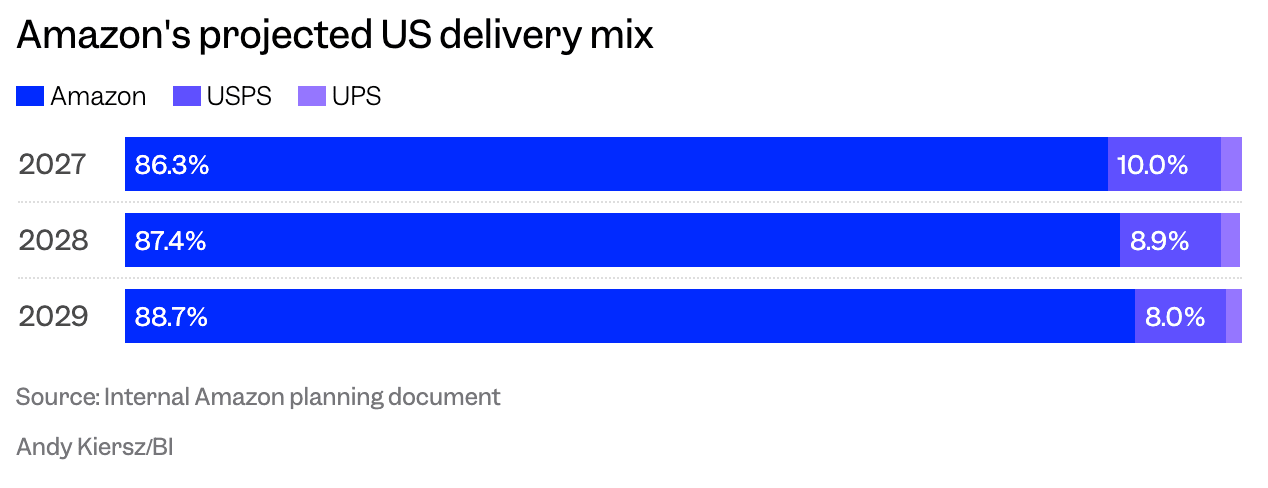
Horizontal bar chart titled "Amazon's projected US delivery mix," showing Amazon, USPS, and UPS share of US deliveries for 2027-2029. Amazon's share grows from 86.3% in 2027 to 88.7% in 2029, while USPS's share falls from 10.0% to 8.0%. Source: internal Amazon planning document, chart by Andy Kiersz/BI.
The End of "Free and Easy" Returns
The era of consequence-free retail returns is officially over, and shoppers are feeling the friction. Driven by the skyrocketing costs of reverse logistics and warehouse processing, major retailers are actively making it harder to return items.
Sixty-eight percent of retailers now charge a fee on returns at least some of the time, up from 43% five years ago, according to Loop Returns, an e-commerce returns-and-exchanges platform that tracks transactions for more than 5,000 merchants. Processing a return costs on average 27% of the purchase price, according to Optoro, a returns-management software company.
Brands are shortening return windows, charging restocking fees, stripping away free mail-in options, and requiring customers to bring items back to physical store locations. While these moves are necessary to protect shrinking margins, the WSJ reports that the sudden rollback of lenient policies is sparking massive consumer frustration.
Source: WSJ
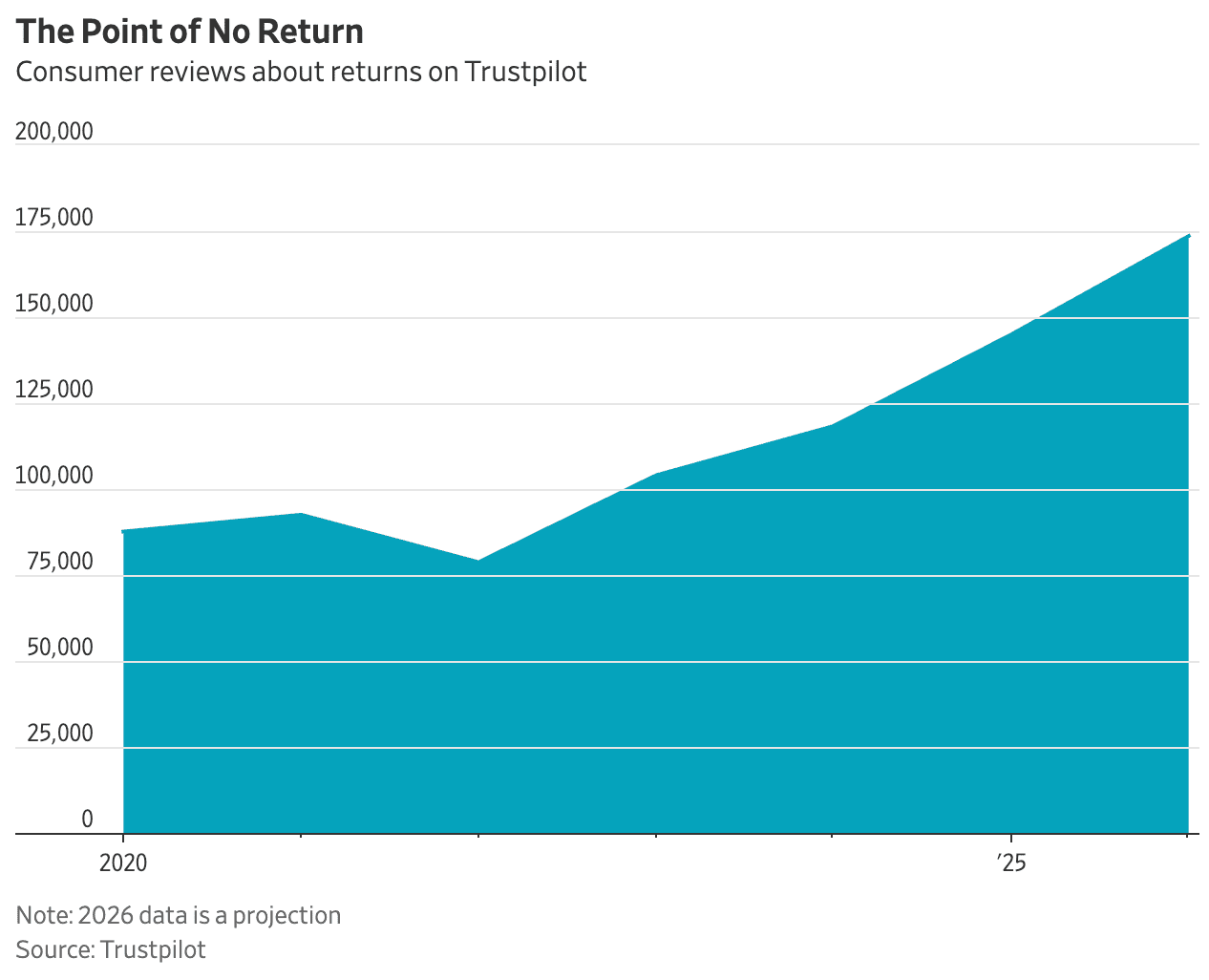
Area chart titled "The Point of No Return: Consumer reviews about returns on Trustpilot," from 2020 to 2026 (2026 is a projection). Volume dipped slightly through 2022 before rising sharply from about 100,000 in 2023 to nearly 175,000 in 2026. Source: Trustpilot.
Pitney Bowes Expands as Parcel Rivals Shut Down
The alternative parcel market is seeing real-time consolidation. Following the sudden closure of two rival logistics and delivery firms, Pitney Bowes is aggressively stepping in to absorb the orphaned volume and expand its own e-commerce services footprint.
Pitney Bowes said its presort services arm helps businesses optimize their mail operations and reduce postage costs through presorting, commingling, transportation, and related services. The organization processes nearly 14 billion pieces of mail annually for more than 2,000 clients through a national network of operations.
This is a stark reminder of how volatile the middle and last-mile carrier space can be right now; while brands want to diversify away from the legacy duopoly, the financial realities of running a competitive parcel network are forcing weaker players out of the market.
Source: DC Velocity
U.S. Imports Carry On Through Extended Peak Season
The traditional holiday shipping peak is stretching much further into the fall than usual. According to the National Retail Federation's Global Port Tracker, September is now projected to be the busiest month of 2026 for U.S. container imports, expected to hit 2.31 million TEUs (up about 10% compared to 2025). That would edge out the current high of 2.3 million boxes that arrived in July. Volumes were expected to drop off earlier than usual this year after many retailers brought in merchandise early to get ahead of potential new tariffs.
Driven by robust consumer spending, front-loading inventory ahead of potential tariff deadlines, and attempts to outmaneuver ongoing supply chain delays in the Red Sea and Panama Canal, retailers are keeping cargo volumes exceptionally high deep into Q4.
Source: WSJ