The USPS Cash Crisis, 2-Hour Delivery & The Cold Storage Thaw: The Latest Logistics News
The USPS Crisis: 8% Rate Hike & 12 Months of Cash Left
The Postal Service is officially sounding the alarm. This week, the USPS announced an emergency 8% rate increase driven by surging fuel costs, which will take effect April 26 and remain in place until Jan 17, pending final approval. But the real headline was the stark warning that accompanied it: the agency stated it only has about 12 months of financial runway remaining before it runs out of cash entirely. With Amazon continuing to pull volume in-house (and overtaking them in total volume last week), the USPS is facing an existential liquidity crisis. Expect major political and operational fallout in the coming months. Source: AP
FedEx Enters the Speed Wars: SameDay Local
While the USPS struggles to survive, FedEx is going on the offensive. The carrier unveiled FedEx SameDay Local, a new service offering 2-hour and end-of-day delivery options. By leveraging its denser, consolidated network (thanks to the "Network 2.0" overhaul), FedEx is taking direct aim at Amazon's same-day dominance and the gig-economy couriers. If you are a brand with localized inventory, this gives you a serious new weapon in your checkout cart. Sources: Supply Chain Dive
Amazon Brings Fast Delivery to Rural America
Amazon isn't just winning the cities anymore; they are coming for the country. The WSJ breaks down how Amazon is completely rewiring rural delivery by bypassing traditional hubs and injecting inventory closer to the "middle of nowhere." By bringing its fast delivery promises to zip codes that competitors historically handed off to the USPS, Amazon is effectively turning rural America into an exclusionary zone for independent brands that can't match their speed. Amazon currently operates around 560 delivery stations across the country, of which around 160 are in rural areas. At its current pace of constructing around 40 to 50 new delivery hubs a year, Amazon will be able to ship packages to every U.S. ZIP Code in four years. Source: WSJ
Cold Storage Vacancies Hit a 20-Year High
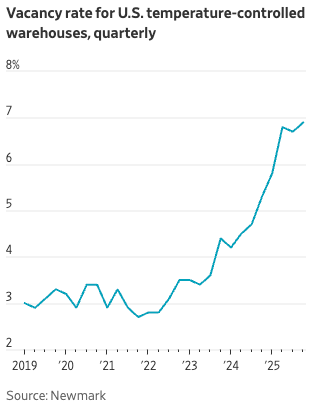
The pandemic-era rush for freezer space has officially thawed. The WSJ reports that cold storage vacancies have hit a 20-year high. After years of aggressive overbuilding driven by the boom in grocery delivery and pharmaceutical needs, the market is now oversupplied. If you are a food or beverage brand looking for temp-controlled space, the negotiating leverage is firmly back in your hands. Source: WSJ
Uber Deploys Delivery Robots & Drones
The autonomous delivery map is expanding. Uber has officially deployed a new fleet of delivery robots and drones, aiming to automate the most expensive leg of the supply chain-the last mile. While still localized to specific test markets, the deployment signals that gig-economy platforms are actively preparing for a future where the driver is optional. Source: Supply Chain Dive
Data Check: Spot Rates Surge on Geopolitical Tension
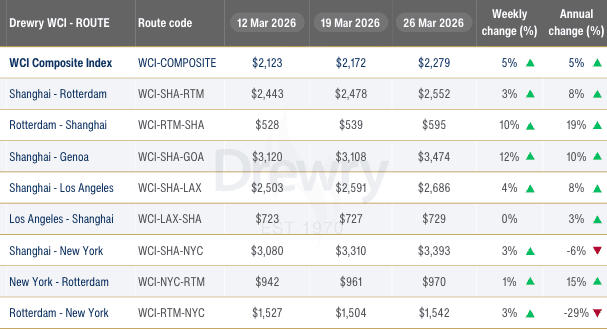
Forget the typical post-Lunar New Year cooldown - the ocean freight market is heating back up. The latest Drewry World Container Index shows rates climbing 5% this week to $2,279 per FEU, marking the fourth consecutive week of increases. The ongoing conflict in the Middle East and disruptions in the Strait of Hormuz are tightening bunker fuel availability in key Asian hubs. Carriers are responding with slow steaming, alternative routing, and emergency fuel surcharges, pushing spot rates higher right when they should be softening. Source: Drewry WCI